English Idioms

تَنْثُرُ الكَونَ عِطرَاً 29-07-2006 95 رد 18,355 مشاهدة
ت
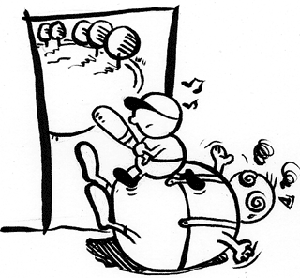
"a drop in the bucket"


A drop in the bucket" is a something that is not important because it is very small. Example: "I'm sorry I scratched your car." Reply: "Don't worry about it. It's just a drop in the bucket. That car has more scratches on it than I can count." There are so many "drops" in a "bucket" of water that we could not count them all, so any one drop is really not that important. Example: "When I think how many people there are in the world, I realize that my own problems are just a drop in the bucket." "A drop" is very small amount when compared with all there is "in the bucket." "A drop in the bucket" is not important because it is a tiny amount when compared to the larger whole. Example: "I'd like to do something to change the world, but whatever I do seems like a drop in the bucket."
ت

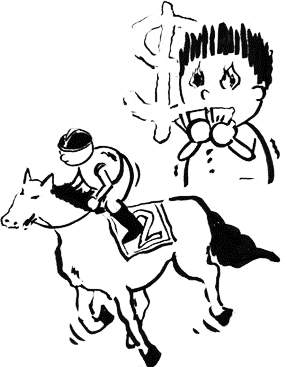
"go for broke"


To "go for broke" is to risk everything on one chance to win big. Example: "Are you sure you want to bet all of your money on that one horse?" Reply: "Yes. I'm going for broke!" To be "broke" is to have no money; you "go for broke" when you risk losing everything for one chance to win big. Example: "Do you think that girl will dance with me if I ask her to?" Reply: "Sure: go for broke!" "Go for broke" means take a risk, try your best, and give all of your energy to something. Example: "The way to be successful is to decide exactly what you want, then go for broke."


ت


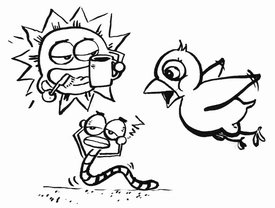
"the early bird (catches the worm)"


The early bird catches the worm means that the person who arrives early will be successful. Example: "I always come early to work. [COLOR="navy"]The early bird catches the worm!"

When birds are competing to catch one worm, the bird that arrives early will catch the worm. Example: "From now on, I am waking up at six. The early bird catches the worm."

At times there is only one "worm" and only one "bird" can catch it, so the bird to arrive early catches the worm. Example: "My brother started investing money when he was 16 years old." Reply: "The early bird catches the worm." [/COLOR]
ت

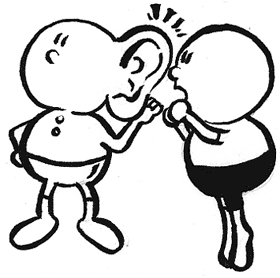
"lend me your ear"


Lend me your ear is a polite way of asking for a person's full attention to listen to what you will say. Example: "Could you lend me your ear for a minute? I need to talk with you about something."

You say lend me your ear when you want to speak directly to people about things that are important. William Shakespeare used lend me your ear in the play Julius Caesar when Mark Antony says: "Friends, Romans, countrymen; lend me your ear."

Lend me your ear requests a closeness between the speaker and the listener that allows them to think together. Example: "This is really important. All I ask is that you lend me your ear."
ت

"keep an eye on him"


To "keep an eye on" someone is to watch that person carefully. Example: "Would you keep an eye on my son for me while I am gone?" Reply: "Sure." You take a share of responsibility for something when you agree to keep an eye on it. Example: "I have to run to the bathroom. Can you keep an eye on my suitcase while I am away?" Reply: "No problem." "Keeping an eye on" someone can also mean watching to make sure that person does not make a mistake. Example: "Be careful what you do today. I'll be keeping an eye on you."
ت

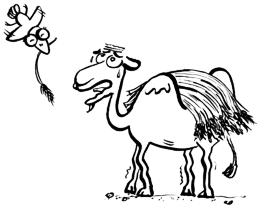
"the straw that broke the camel's back"


The straw that broke the camel's back is the last thing you are willing to accept after which you will not put up with any more. Example: "You broke a lot of rules and we tried to ignore it. But stealing money from us was the straw that broke the camel's back. We're sending you home to your parents."

You are at the last straw when you are just about to lose your patience. The straw that broke the camel's back is the last thing that that happened that finally made you upset. Example: "He came to work late every day that week. Then on Friday, he didn't show up at all." Reply: "That was the straw that broke the camel's back."

There is a limit to how much straw (long yellow grass) a camel can carry on its back. If you keep putting more straw on top, it will finally break the camel's back. When you are at the last straw you are finally angry and will not take any more. Example: "You have been rude to me all day. I've had it. That's the last straw!"
ت

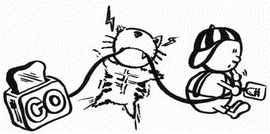
"curiosity killed the cat"


Curiosity killed the cat reminds us that being too curious can be dangerous. Example: "What do you think is down that dark street?" Reply: "I would rather not find out.[COLOR="Navy"] Curiosity killed the cat."


Curiosity killed the cat recalls a story in which "the cat" was killed because he was too curious and followed "curiosity" too far. Example: "That reporter has been asking a lot of questions and the boss doesn't like it." Reply: "Curiosity killed the cat."


Cats are curious animals that like to investigate, but their curiosity can take them places where they might get hurt. Children especially, like cats, are curious and like to test to find out what is dangerous. Example: "My son stuck his finger into the electrical outlet and got a huge shock! He said he wanted to find out how it would feel." Reply: "It's a good thing he wasn't hurt! Curiosity killed the cat[/COLOR]."
ت
"out of the blue"


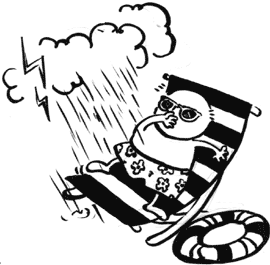
Something that happens out of the blue is sudden and unexpected. Example: "They seemed to be talking calmly when out of the blue she slapped him in the face!"

It is as if suddenly it started raining on a day when the sky was clear and blue. Example: "Why did she do that?" Reply: "I have no idea. It was completely out of the blue."

You are surprised and unprepared when it happens out of the blue. Example: "Did you know they would move you to a different project?" Reply: "Not at all. It was completely out of the blue."
ت

"all in the same boat"


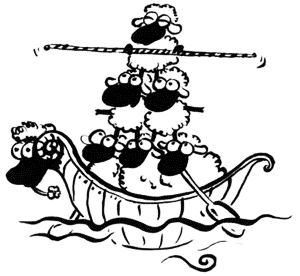
People who are [COLOR="Navy"]all in the same boat must work as a team because they face the same challenges together. Example: "We can't fight against each other. We need to work together. We're all in the same boat!"

When people forget that they are part of a team, we can remind them by saying, "We are all in the same boat". Example: "I'm so busy. I don't know how will get this done." Reply: "You're not the only one with a lot to do. We are all in the same boat."

We are all in the same boat means that we are all like people who are in the same boat so we need to cooperate in order to succeed. Example: "These may be difficult times, but we're all in the same boat. We can get through it together." [/COLOR]
ت

"dog-eat-dog"


Dog-eat-dog describes a world in which people fight for themselves only and will hurt other people. Example: "I have been in this business for twenty years. It's dog-eat-dog. The competition is always trying to steal your customers."

Dog-eat-dog means that a person is like a dog that will eat another dog. Sometimes people say, "It's a dog-eat-dog world", as an excuse when they have hurt another person. Example: "I can't believe you sold him your motorcycle for so much money!" Reply: "Hey, it's a dog-eat-dog world."

It's a dog-eat-dog world means that you must first watch out for your own interests, because other people will be watching out for theirs. There is no letter s at the end of any of the words in dog-eat-dog. "Example: "That school is dog-eat-dog. The students cheat and even destroy each other's work to get better grades."
ت

"birds of a feather (flock together)"


Birds of a feather flock together means that people who are similar to each other often spend time together. Example: "Those guys work at the same company and go to the same bars. They do everything together." Reply: "Birds of a feather flock together."

We know that birds are of the same type when they have the same feathers; they are of a feather. Birds flock when they join together in groups with other birds. Just as birds "of a feather" often flock with other birds of the same "feather", so do people who are like each other spend time together. Example: "Are Timmy and his friends going to that same bar again?" Reply: "Sure they are. Birds of a feather flock together."


People ("birds") who are similar to each other ("of a feather") often spend time ("flock") with each other ("together"). Example: "Look. The volleyball players are eating together at the same table again, as always." Reply: "Birds of a feather flock together."
a
مشكورة وماقصرتي ،،،
ت
[glow=FFFFFF]

العفو :)

للموضوع بقية

تابعى معنا :salam: [/glow]
ت

"out of the frying pan (and into the fire)"


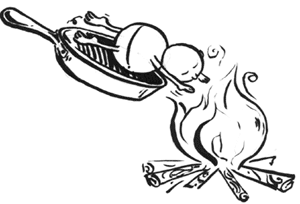
To go out of the frying pan and into the fire is to get out of one difficult situation only to end up in another. Example: "I worked too hard on that last project. But on this new project I am working even harder!" Reply: "Out of the frying pan and into the fire."

We sometimes want so much to get out of one difficult situation that we end up jumping into another that is even worse, going out of the frying pan and into the fire. Example: "Her ex-boyfriend was terrible, but this new one is even worse!" Reply: "Out of the frying pan and into the fire."

"The frying pan" is a very hot place to be because it is over "the fire". In a difficult situation, the first thing we want to do is get out of that situation. Example: "They think they work hard now. Wait and see how much harder they have to work after they graduate." Reply: "Out of the frying pan and into the fire."
ا


..

VERY VERY VERY INTERESETING

there were some other threads about idioms that were posted some time earlier but i find yours to be really interesting , needless to say, because of the very clear explanations and illustrations included..

i don't think anyone would have an excuse for not understaning idioms after reading your topic..

i have a book full of them,, their origin and explanations and all.. but i will not add any before you finish all you have..

after that if i find anything missing.. i will add some..

thank you so much dear.. and please do continue..

we are following..

thanks again

and keep it up

:flower: :flower: :flower:
آ
Really I don't know how to thank you it is so ineresting and exciting to know something like that

:handup: :qaq: :handup: :qaq: :handup: :qaq:
Many thanks honey

May allah bless you dear.

Regards


:clap: :clap: :clap: :clap: :clap:
d
WOW:clap: :clap: :clap:
WHAT A VERY USEFUL SUBJECT:ok: :ok: :ok: :ok: :ok: :ok:
PLEASE KEEP ON PROVIDING US WITH SUCH INTERESTING STUF
ت
[glow=FFFFFF]I am very very happy for your reply


:smile:[/glow]
ت
"sink or swim"


"Sink or swim" is a situation where you will either fail or you will find a way to succeed. " Example: "Sales is not an easy job here. We give you two weeks training, then it's sink or swim." If you are thrown into the water, you will either sink to the bottom or you will swim to safety. You will either fail, or you will find a way to succeed, in a situation that is sink or swim. Example: "How do you interview new teachers here?" Reply: "We just put them in with the kids, and see how they do. It's sink or swim." Sink or swim" means that you will either succeed, or you will fail completely, at what you are trying to do.
ت

"over my dead body"


When you absolutely will not allow a person to do something you might say "over my dead body." The [literal] meaning is that you will stand in the way of that person and only if they kill you and walk over your dead body will they be able to do what they want. Example: "You kids are not going out in the cold without your jackets! Not over my dead body!" Parents say "over my dead body" often because they are in a position of authority and they are much bigger than their children. Example: "All of my friends are going out to the lake tonight and I'm going too!" Answer: "Over my dead body you are!"
X