English Idioms

تَنْثُرُ الكَونَ عِطرَاً 29-07-2006 95 رد 18,355 مشاهدة
ت
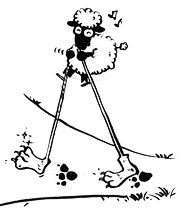
"finding your feet"


You are "finding your feet" when you are learning what to do and becoming more comfortable acting in a certain type of situation. Example: "I've only been at this job for a few months. I'm just finding my feet." It takes time to find your feet, because you need to learn what to do and become comfortable doing it. Example: "I was at that job for over a year before I really found my feet." You have gained the needed skills and are performing your job well, once you have found your feet. Example: "Don't worry about it. We will help you out until you find your feet."
ت

"lost his head"


You lose your head when you get upset and lose control of your actions. Example: "I got so angry yesterday. I completely lost my head." Example: "I'm really sorry about what I did. I lost my head."

You are overcome by emotions (especially anger) and lose control of your actions when you lose your head. Example: "Okay, I'll tell you what happened. But first promise that you won't lose your head."

A person who loses his head is not in control of his actions because is not thinking clearly. Example: "He lost his head, so they threw him out of the game."
ت

"going against the grain"


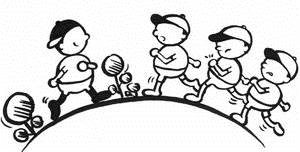
You go against the grain when you make life more difficult by acting against the wishes of others. Example: "Why can't you just do it the way everyone else does? Why do you always have to go against the grain?"

Wood grows in a way that makes it easy to cut in one direction (with the grain) and hard to cut in the other direction (against the grain). Example: "I jog at this track every day and there is always that one guy who has to go against the grain and run in the opposite direction."

To go against the grain is to do things in a way that is different from what is normal and accepted. Example: "You can't always follow other people in life. Sometimes you need to go against the grain to do the right thing."
ت

"truer words were never spoken"


You say Truer words were never spoken when you strongly agree with what the other person has just said. Example: "I find that the earlier I get up, the better the day I have." Reply: "Truer words were never spoken. The morning hours are definitely the best hours of the day."

Truer words were never spoken is often used as a single sentence response to support the other person, showing how strongly you agree. Example: "This is the best cake I have eaten in years!" Reply: "Truer words were never spoken."

When someone says something that you find to be very true and which applies in many different situations, you can say, "Truer words were never spoken." Example: "You are lucky to have such a wonderful wife." Reply: "Truer words were never spoken."
ت

"nose out of joint"


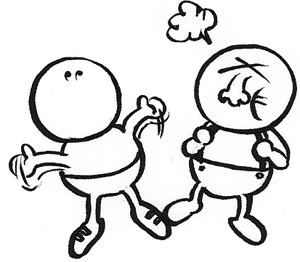
Your "nose is out of joint" when the look on your face and the way you act shows other people that you are upset. Example: "What's wrong with him?" Answer: "His nose is out of joint because we forgot to invite him to the party." Although a nose cannot actually be "out of joint", the way a finger or an arm comes out of joint, a person who is upset may have a strange look on their face until they recover. Example: "What happened was an accident; there is no reason for you to have your nose out of joint." Another example: "We were only joking; don't get your nose out of joint."
ت

"the pot calling the kettle black"


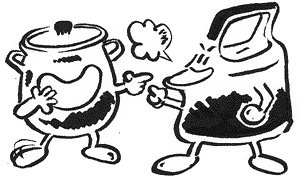
You are the pot calling the kettle black when you point to another person and accuse that person of doing something that you are guilty of doing yourself. Example: "You are accusing me of being lazy? Ha! That's the pot calling the kettle black!"

"The pot" (for cooking) and "the kettle" (for boiling water) sit on the stove over the fire and become black from the flames. Example: "I'm tired of you always wearing my clothing!" Answer: "Aren't you the pot calling the kettle black? You're wearing my pants right now!"

The pot and the kettle are like old friends who have turned black with time; the pot only sees the blackness which is on the kettle; he doesn't see the black on himself. Example: "Here comes the guy who is always late for work." Answer: "Aren't you the pot calling the kettle black? You are usually the last person to show up!"
ت

"when in rome (do as the romans do)"


When in Rome, do as the Romans do means that when you are visiting a new place, you should try to do as the people do who are from the place. Example: "I can't eat that." Reply: "Oh, give it a try. When in Rome, do as the Romans do."

People from different places have different ways of acting, so it is important to try to do things the way people do who are from the place that you are visiting. Example: "Are you sure we can eat this with our hands?" Reply: "Why not? All of these people are. When in Rome, do as the Romans do."

The city of Rome was the capitol of the great Roman Empire. There were many strange and interesting things to do when visiting ("in") Rome. Example: "Back home, we never sing in front of other people." Reply: "Oh, come on. Give it a try! When in Rome, do as the Romans do."
ت

"burning the midnight oil"


You are "burning the midnight oil" when you are working hard late into the night. Example: "I could see the light in your window last night. It looks like you have been burning the midnight oil." Before they had electric lamps, people used oil-burning lamps to read or work in the darkness at night. When you are working very hard until late at night you are "burning the midnight oil." "Has your son been working hard to prepare for his final exams?" Reply: "He sure has. He's been up each night burning the midnight oil."
ت

"can't cut the mustard"


When you are not able to perform at the required level, you can't cut the mustard. Example: "Did you hear that Williams got fired?" [COLOR="magenta"]Reply: "Yes. He couldn't cut the mustard."

It is as if cutting "the mustard" were some test that you had to pass in order to belong. If you can't cut the mustard, you are not allowed to participate. Example: "Bob dropped out of medical school." Reply: "Why?" Answer: "He just couldn't cut the mustard."

If you don't work hard enough, or if you just aren't good enough, you can't cut the mustard. Example: "So, do you think you will be able to cut the mustard?" [/COLOR]
ت

"better late (than never)"


Better late than never means that it is better to do something late than to never do it at all. Example: "The movie has already started. Do you still want to go in?" Reply: "Sure. Better late than never!"

Better late than never is often used as a polite way to respond when a person says "sorry" for being late. Example: "Sorry I was late for the meeting today. I got stuck in traffic." Reply: "That's okay. Better late than never."

Better late than never means that even if you are going to be late, you should still go ahead and do the thing, because it is better to do it late than to never do it at all. Example: "I'm sorry it has taken me so long to return this book." Reply: "Better late than never."
ت

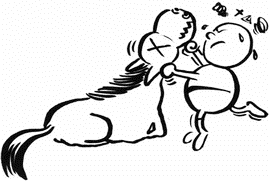
"beating a dead horse"


You are beating a dead horse when you insist on talking about something that cannot be changed. Example: "I'd like to talk with you again about what happened." Reply: "Oh, come on. Let's not beat a dead horse."

Beating a dead horse is an action that has no purpose, because no matter how hard or how long you beat a dead horse, it is not going to get up and run. Example: "Let's not talk about it any more. Okay?" Reply: "You're right. We're just beating a dead horse."

To repeatedly bring up a particular topic with no chance of affecting the outcome is beating a dead horse. Example: "Dad, are you sure we can't get a new computer for the upstairs?" Reply: "Son, we talked about this and the decision was 'no'. You are beating a dead horse."
ت

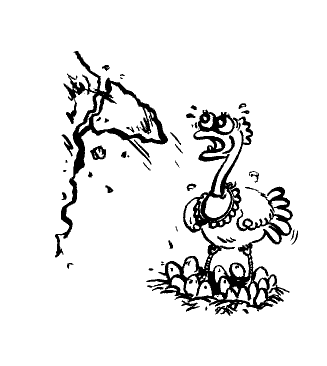
"don't count your chickens (until they've hatched)"


"Don't count your chickens until they're hatched" means that you can hope certain things happen in the future, but you cannot know for sure that they will happen until they actually do happen. Example: "Do you think that Bill is going to offer you a promotion this month?" Reply: "I won't count my chickens until they have hatched." "Chickens" start out as eggs, and you can count the eggs, but not all of the eggs will hatch to become chickens. "Don't count your chickens until they've hatched" means don't make plans based on something happening until that thing has already happened. Example: "Next Friday I will finally be able to pay you back that money I owe you." Reply: "Ha. I won't count my chickens until they have hatched." "Don't count your chickens until they've hatched" means that you should not count on something happening until you are sure that it will happen.
ت

"word of mouth"


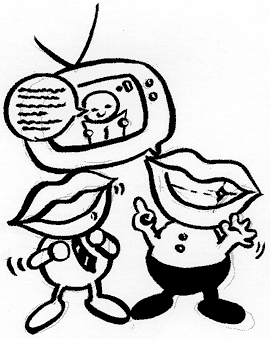
Something that you heard from other people you know by word of mouth. Example: "How did you hear about this party?" Reply: "Word of mouth."

When you say that you heard something word of mouth, you are not being specific about whose mouth you heard it from; just that you heard it from another person. Example: "There has been talk at school about canceling the concert." Reply: "Really? Who did you hear that from?" Answer: "Just word of mouth."

We do rely on what other people tell us, so word of mouth is one important way that we learn things. If something is "only" (or "just") [COLOR="navy"]word of mouth then you might not know where the "word" really started or how it changed as it went from "mouth" to "mouth". Example: "Did you hear they finally arrested that guy?" Reply: "Yes, but that's only word of mouth." Example: "Where did you hear that?" Reply: "Just word of mouth[/COLOR]."
ت
"cross your fingers"


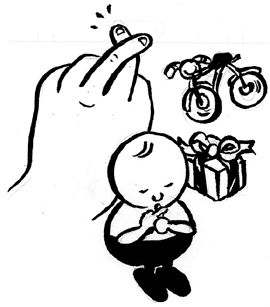
An old superstition says that if you cross your fingers (usually two fingers of the same hand) it will bring good luck. Example: "I don't know what I will get for my birthday, but I am crossing my fingers that it will be a bicycle."

You cross your fingers when you try to make something happen by wishing that it will happen. A common saying: "Let's cross our fingers and hope for the best." Example: "Good luck on your test tomorrow. We'll be crossing our fingers for you!" Reply: "Thanks."

The meaning of don't cross your fingers changes a bit. It means don't hope too much for what you want to happen, because there is a strong chance that it might not happen. It means that you should not have expectations that are too high. Example: "It would be great if our team won today, but don't cross your fingers." Example: "We are hoping that John will get accepted to medical school, but we are not crossing our fingers."
ت

"everything but kitchen sink"


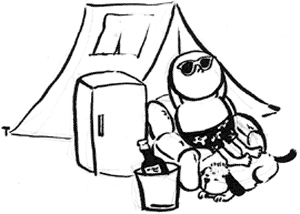
Everything but the kitchen sink is what you brought with you when you included almost everything you could think to bring. Example: "Wow, your suitcase is huge. What do you have in there? Everything but the kitchen sink?"

When we we are deciding what to bring with us, we try to take everything possible. But some things, like the kitchen sink, are just not convenient. Example: "Every time we go camping my wife packs everything but the kitchen sink."

Everything but the kitchen sink means that you included almost everything you could think to include. Example: "My dad's new luxury car is great. It has everything but the kitchen sink."
ت

"tie the knot"


When two people get married, they "tie the knot." Example: "After dating for five years, we finally decided to tie the knot." When you tie "a" knot you wrap two pieces of rope around each other in a certain way so that they will not come apart. When you tie "the" knot you make a promise that you will stay together with one person whom you love. Example: "Did you hear about Dan and Jenny? They finally decided to tie the knot." Two people are like two ropes and they get married to tie "the knot" which keeps them together. Example: "So, when are you two going to tie the knot?"
ت

"put your best foot forward"


Putting your best foot forward is stepping forward and doing your very best. Example: "This week the division manager will be in town. I want each of you to putting your best foot forward."

To show others (put... forward) your best effort (your best... foot) is putting your best foot forward. Example: "Don't be shy, son. I want you to get out on that field and put your best foot forward!"

You say put your best foot forward to encourage others to try hard and do their best. Example: "If every man puts his best foot forward, we will win this game."
ت

"an about face"


You do "an about face" when you begin facing one direction, then you turn completely to face in the opposite direction. Example: "If you ever discover that you are walking down a dangerous street, it is best to do an about face and walk in the other direction." You "do an about face" when you stand facing north, for example, then turn your body in one step until you face south. The term "about face!" is used in the military: The drill sergeant shouts "About face!" and all of the soldiers turn in one step to face the opposite direction. Example: "I want you to do an about face, get back in that bathroom, and brush your teeth!" To "do an about face" is also to change your position on something and take the opposite position.
ت
"when it rains, it pours"


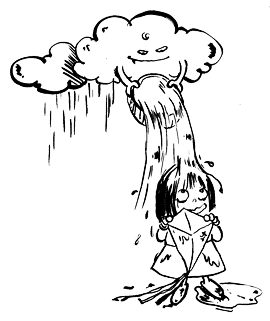
When it rains, it pours describes how after there has been no rain for a long time, it suddenly rains a lot all at once. Example: "It hadn't rained for over two months. Now it has started raining and it has been raining for a week straight." Reply: "When it rains, it pours."

When it rains, it pours means that once something happens after a long pause, it happens in large amounts. Example: "It looks like everyone in our department is sick again, and all at the same time." Reply: "When it rains, it pours."

When there is a lot of rain all at once we say that it is pouring. Some people say, It never rains, but it pours; the meaning is the same as When it rains, it pours. Example: "Sometimes we have no customers for two or three hours, then suddenly we get 20 people all at once." Reply: "It never rains, but it pours."
ت

"turn over a new leaf"


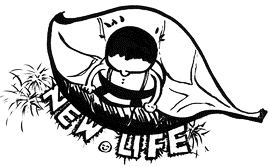
When you decide to do something different to change your life for the better, you are turning over a new leaf. Example: "This year I've joined a gym and I am exercising every day. I'm turning over a new leaf."

Turning over a new leaf is like turning over a new page ("leaf") in your life and seeing what is on the other side. Example: "Wow. Look how polite your son has become." Reply: "Yes. We had a big talk with him, and he has really turned over a new leaf."

You turn over a new leaf when you commit to changing your life for the better. Example: "I'm turning over a new leaf: I've decided to quit smoking. "
X